

HOSPITALITY ENERGY CASE STUDY
A coordinated approach to solar, battery reserve and generator support, designed around the way a lodge operates.
SECTOR
IMPORT OBJECTIVE
PRIORITY
PROJECT STATUS
PROJECT OVERVIEW
This case study is based on a real lodge power project undertaken by Zamori Engineering Services for a hospitality client. The client and property are anonymised to protect confidentiality.
Lodge solar and battery storage must respond to a daily operating pattern. Daytime solar may be plentiful while guests are out. Evening demand can rise after that generation has fallen, just as the property needs power for guest services and site operations.
A battery can help bridge those periods. Its available reserve, the utility connection and generator support determine what the complete system can deliver.
Zamori’s project study considered the lodge as one coordinated electrical system. It examined grid-import control, useful solar generation, protected battery reserve and generator support alongside the electrical integration required to make the operating strategy work.
STUDY CONTEXT
A real Zamori project, presented as an anonymised engineering case study. Public equipment scales are rounded and operating profiles are illustrative. The study explains design objectives; it does not claim measured savings or guaranteed outage autonomy.
Zamori Engineering Services
September 2026
ASSESSMENT PRIORITIES
01
Use available solar to serve the lodge and replenish the battery.
02
Control utility import within a project-specific operating objective.
03
Retain battery energy for critical services and unexpected outages.
04
Use generator support when demand, poor solar or depleted storage requires it.
05
Coordinate the source interfaces, protection and operating controls.
ENGINEERING STUDY / 01
The study compared site demand with solar availability and battery response. Its import-control objective was approximately 65–70 kW of maximum utility import, a rounded project-specific target rather than a recommended limit for other properties.
In the representative daily profile, solar served daytime loads and reduced grid import. Battery discharge supported periods when the demand remaining after solar would otherwise exceed the import target.

Illustrative daily demand-control profile. The dashed line shows a 70 kW utility-import objective. Curves explain the intended operating approach; they are not measured client performance. View the full-size diagram.
That gave the battery an active role in demand management alongside its backup function. Whether the target could be maintained depended on the actual battery, converter, feeders and protection equipment, as well as the energy available at the time.
The tariff and its billing intervals also mattered. A reduction shown in a representative kilowatt profile could not simply be translated into a Rand saving without checking how the property was charged.
ENGINEERING STUDY / 02
State of charge, often abbreviated to SOC, describes how much charge remains in the battery. It is an operating input, but a high percentage alone does not establish how long a lodge can remain supplied.
The study's operating philosophy combined a high daytime charge target, a protected minimum and a margin for starting generator support. Where conditions justified it, additional charging before the evening period could improve the reserve available for the next demand peak.

The reserve diagram separates the protected minimum, generator-start margin, normal dispatch range and high-charge headroom. View the full-size visual.
These thresholds needed to be considered alongside the critical loads, converter power and expected duration of an outage. Energy committed to daily cost reduction could not simultaneously be assumed available for emergency support.
The assessment also looked beyond a single day. Several days of reduced solar could change the battery's recovery pattern and increase dependence on the utility supply or generators. Weekly analysis helped identify those conditions before they became operating assumptions.
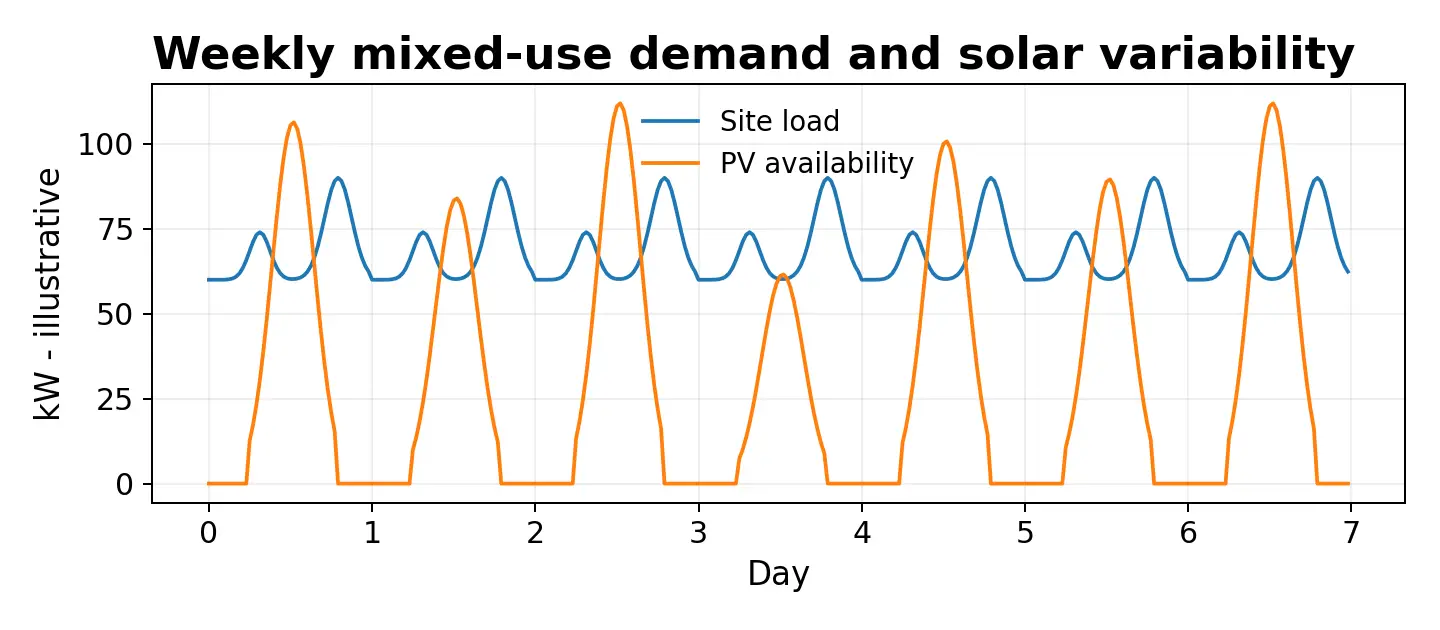
The weekly profile shows why one sunny day is insufficient for planning: demand repeats while solar availability changes and battery recovery must be checked. View the full-size visual.
ENGINEERING STUDY / 03
The project study considered two generator sizes to support different duties. Short-duration assistance and sustained standby operation were treated as distinct requirements.
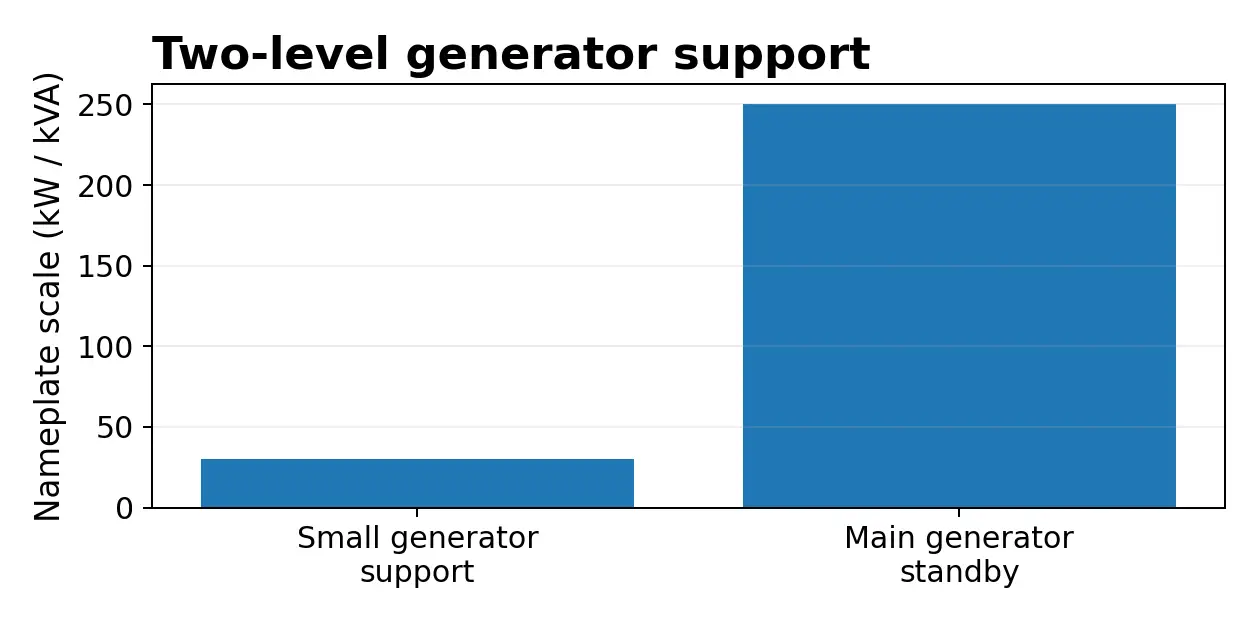
The supplied chart distinguishes smaller-generator assistance from main-generator standby. The two sizes serve different operating and endurance duties. View the full-size visual.
The controls needed to determine when a generator should start, which loads it should support and how the system would recover afterwards. Poor solar, a prolonged grid interruption or a declining battery reserve could each require a different response.
The objective was to avoid unnecessary running hours while retaining an endurance source when solar and stored energy were insufficient. The largest generator was not automatically the preferred source during normal operation.
This required realistic attention to generator capability and the electrical transition. Fuel savings and uninterrupted guest services could not be assumed solely from the presence of both a battery and a generator.
ENGINEERING STUDY / 04
The energy model needed an electrical design behind it. Utility supply, solar, storage and generators each had to connect through defined interfaces, with protection and control arrangements suited to the operating states.
The integration assessment considered source isolation, earthing and earth-fault protection, breaker duty, transfer logic, emergency isolation and battery thermal management. Cable routes and access for inspection and maintenance formed part of the same work.

Representative system overview. Equipment values are rounded to preserve anonymity. This conceptual diagram explains the source relationships; it is not a construction drawing or a protection specification. View the full-size diagram.
An energy management system, or EMS, coordinates the operating sequence: normal solar and battery use, import control, low-charge support, grid-loss operation and controlled recovery. The proposed layout also distinguished the battery and power-conversion equipment zones, with separate power and communication routes.
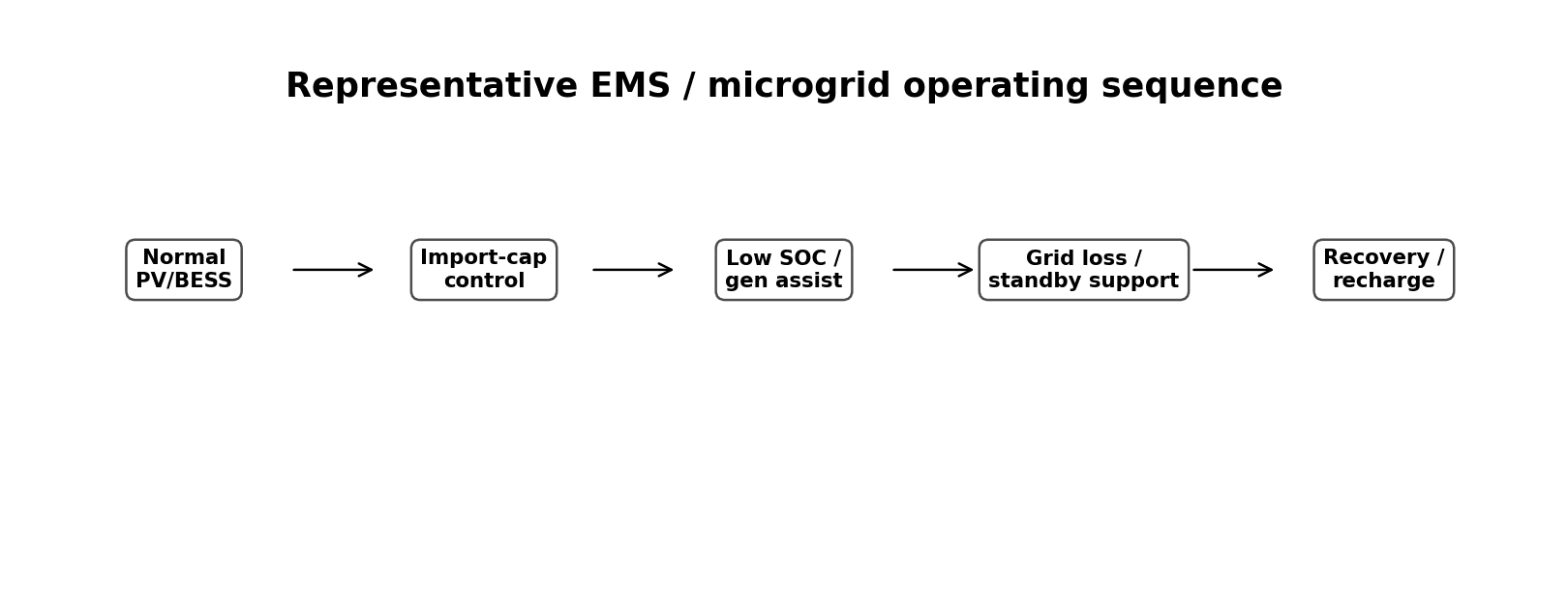
The energy-management sequence links normal operation, import control, low-charge support, grid-loss standby and recovery. View the full-size visual.
Power and communication routes also needed coordination. The control system had to translate its operating decisions into appropriate inverter, breaker and generator actions, within the equipment's real capabilities.
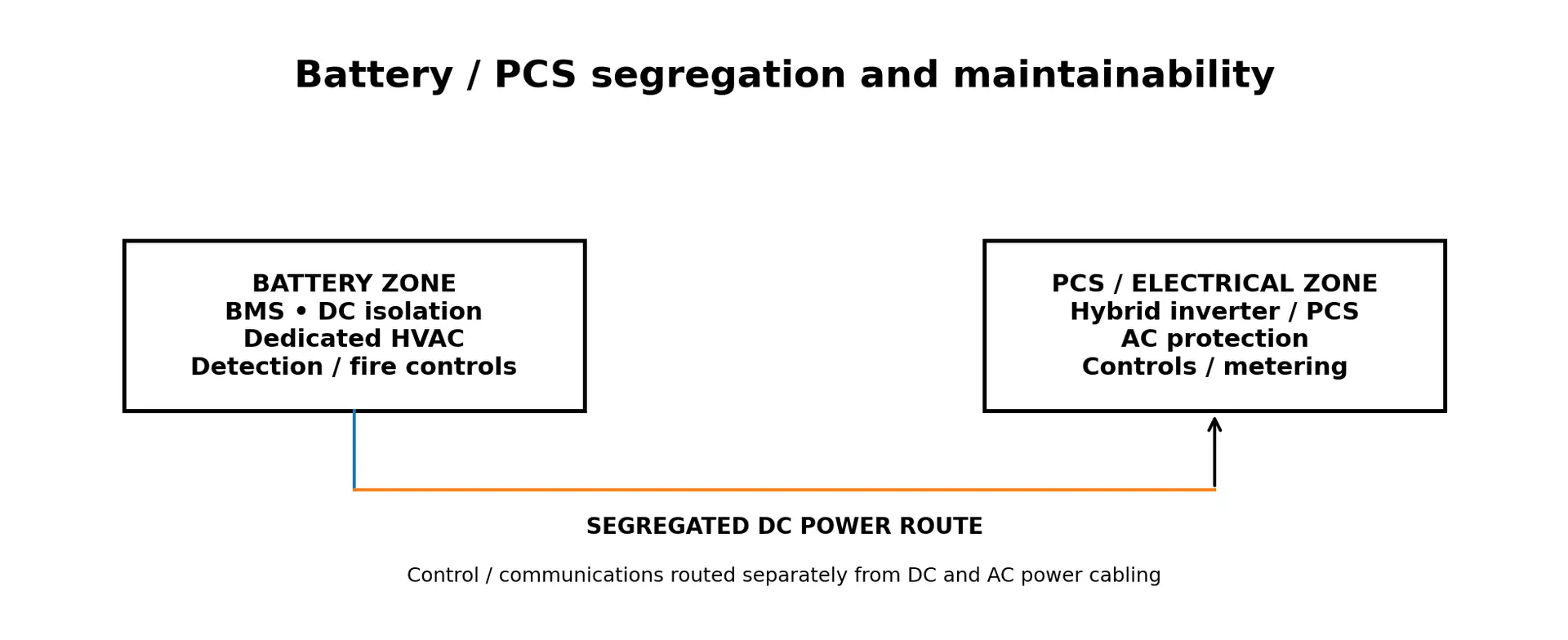
Separate battery and power-conversion zones support protection, thermal management and maintenance, with power and communication routes coordinated. View the full-size visual.
For battery-location and emergency-planning considerations, see our guide to commercial battery storage.
ENGINEERING STUDY / 05
The study developed a coordinated approach to reducing grid peaks, using solar effectively and managing reserve without overlooking continuity. It connected those objectives to the interfaces that an electrical design would need to resolve.
The next stage for a property considering a similar system would require verified load profiles, applicable tariffs, final equipment limits and project-specific engineering. Commissioning would then need to demonstrate that the controls and source transitions operated as intended.
No verified before-and-after dataset or site-specific financial result is presented here. The case study shows the value of planning the sources together before treating solar panels, batteries or generators as separate purchases.
HOSPITALITY ENERGY PLANNING
Zamori can assess a lodge or hospitality property's demand, existing solar and backup equipment, critical services and electrical infrastructure.
That assessment can inform a new system, an expansion or a review of how existing equipment operates together.
How a whole-plant assessment connected source data, power factor and investment planning.
What owners should monitor and what a professional inspection should cover.
Publication basis: a real hospitality engineering project undertaken by Zamori, documented in its anonymised lodge case-study material. Client identity, exact feeder names, equipment model numbers, communications details and protection settings are withheld. Equipment scales and operating profiles explain the design approach and are not an installation guarantee. Cover photographs are illustrative and do not identify the study site.